Monday, May 3, 2010

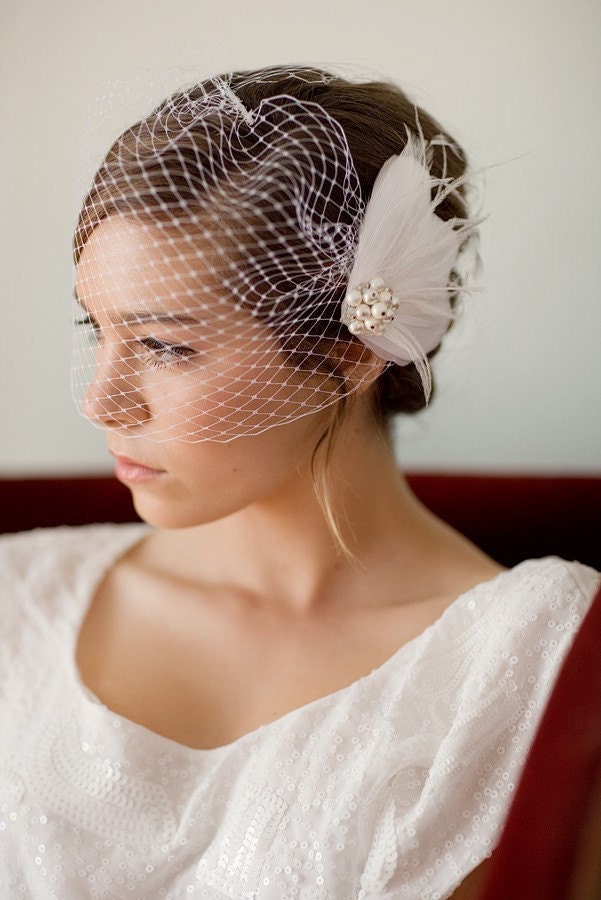
a veil i always knew i wanted, but now that i have it, i don't know how to wear it!

When I realized I was getting married, I already knew what my "look" would be.  I've always had a soft spot for the vintage celebration of femininity and knew that I wanted lace, lots of it.  I also knew what sort of veil I wanted- the birdcage type; it speaks of a different era and its femininity is less puritan and more so that of a woman with confidence and flirtatious style.  Maybe i'm just making shit up.

Last week I received my birdcage veil, and that's when I found that I have no clue how to wear it!  It's quite funny actually because I have seen hundreds of pictures of models wearing these and never did it occur to me that well, it probably looked easier on "paper"!  And that's how my research began.


Veil source: LoBoheme, Etsy.com


So class, here's a bit of history on the wedding veil courtesy of Wikipedia, some of the history is quite interesting.


History

The first recorded instance of veiling for women is recorded in an Assyrian legal text from the 13th century BCE, which restricted its use to noble women and forbade prostitutes and common women from adopting it. Ancient Greek texts have also spoken of veiling and seclusion of women being practiced among the Persian elite. Statues from Persepolis depict women both veiled and unveiled, and it seems to be regarded as an attribute of prostitution.
Classical Greek and Hellenistic statues sometimes depict Greek women with both their head and face covered by a veil. Caroline Galt and Lloyd Llewellyn-Jones have both argued from such representations and literary references that it was commonplace for women (at least those of higher status) in ancient Greece to cover their hair and face in public.
For many centuries, until around 1175, Anglo-Saxon and then Anglo-Norman women, with the exception of young unmarried girls, wore veils that entirely covered their hair, and often their necks up to their chins (see wimple). Only in the Tudor period(1485), when hoods became increasingly popular, did veils of this type become less common.
[...]

Wedding veils

An occasion on which a Western woman is likely to wear a veil is on her wedding day, if she follows the traditions of a white wedding. Brides used to wear their hair flowing down their back at their wedding to symbolise their virginity, now the white diaphanous veil is often said to represent this.
It is not altogether clear that the wedding veil is a non-religious use of this item, since weddings have almost always had religious underpinnings, especially in the West: in the Christian tradition this is expressed in the Gospel passage, "What therefore God has joined together, let no man put asunder" (Mt. 19:6). Veils, however, had been used in the West for weddings long before this. Roman brides, for instance, wore an intensely flame-colored and fulsome veil, called the flammeum, apparently intended to protect the bride from evil spirits on her wedding day.
The lifting of the veil was often a part of ancient wedding ritual, symbolising the groom taking possession of the wife, either as lover or as property, or the revelation of the bride by her parents to the groom for his approval.
In Judaism, the tradition of wearing a veil dates back to biblical times. When Rebekah went to meet her betrothed, Isaac, she veiled herself as he approached. The veiling was both a symbol of modesty, and a definition of her personal space. Rebekah is known as the most self-assured of the matriarchs, and by veiling herself she indicated that she would still be her own person even when she would be living her life with Isaac. [8]. It is important to note that Rebekah did not veil herself when traveling with men to meet Isaac, but only did so when he was approaching. Just before the wedding ceremony the badeken or bedeken is held. The groom places the veil over the bride's face, and either he or the officiating Rabbi gives her a blessing. The veil stays on her face until just before the end of the wedding ceremony - when they are legally married according to Jewish law - then the groom helps lift the veil from off her face.
The most often cited interpretation for the badeken is that when Jacob went to marry Rachel, his father in law Laban tricked him into marrying Leah, Rachel's older and homlier sister. Many say that the veiling ceremony takes place to make sure that the groom is marrying the right bride! Some say that as the groom places the veil over his bride, he makes an implicit promise to clothe and protect her. Finally, by covering her face, the groom recognizes that he his marrying the bride for her inner beauty; while looks will fade with time, his love will be everlasting. in some ultra-orthodox traditions the bride wears an opaque veil as she is escorted down the aisle to meet her groom. This shows her complete willingness to enter into the marriage and her absolute trust that she is marrying the right man. In Judaism, a wedding is not considered valid unless the bride willingly consents to it.
In ancient Judaism the lifting of the veil took place just prior to the consummation of the marriage in sexual union. The uncovering or unveiling that takes place in the marriage ceremony is a symbol of what will take place in the marriage bed. Just as the two become one through their words spoken in wedding vows, so these words are a sign of the physical oneness that they will consummate later on. The lifting of the veil is a symbol and an anticipation of this.
In the Western world, St. Paul's words concerning how marriage symbolizes the union of Christ and His Church may underlie part of the tradition of veiling in the marriage ceremony [9].

Sunday, April 11, 2010

The Shoe Dilemma

I have to admit, I really like shoes.  When I was in college I did a mini documentary or video piece for one of my classes about shoes; how they're a reflection of the wearer's personality.  At first i thought there would  be instances where it wouldn't hold true, but to my surprise, I don't think I came across a single one of them.  Then again, I think you can say the same about many things: hair, handbags, accessories, etc.  But I chose shoes.

Take the following people for example:
Molly- has a pair (that i've seen) of Chanel boots, not sure if she owns a pair of Louboutin's but I wouldn't be surprised if she did
Fred - only wears skater shoes and paratrooper boots
Stanley - Merrel's that I can remember

I would even say I have my own style, which Fred most often than not describes as "awful, gaudy, old-lady-like", except for when i wear the black and red tartan Doc's (those he likes).  So finding the right pair of shoes for my wedding is well, a bit of a task.  I've always chosen my shoes based on whether they're fun, spontaneous, practical, or safe.  The later usually reserved for the office.  But a wedding is different, they have to match my dress, fit well, and above all, I have to be able to walk in them.

I've been browsing and so far here are some audacious options that are way out of my price range.  Sad thing is that I actually wouldn't mind paying the price, but knowing that I wouldn't wear them past the wedding reception makes any of these options highly unlikely.


Christian Louboutin - Spiked Patent Pump
Price $885
(yep those are spikes indeed)


Oscar de la Renta - Jewel-toe Platform Pump
Price $685


Yves Saint Laurent - Chloris 105 Sandal
Price $895


Ralph Lauren - Jacoba Metallic Napa Sandal
Price $1,150
(those are Swarovski crystals)


Christian Louboutin - Glitter Slingback Platform Pump
Price $745


Christian Louboutin - Hidden-Platform Pump
Price $795
(these look fun but not dressy enough)


Christian Louboutin - Fetilo Peep-toe Pumps
Price $995


source: NeimanMarcus.com, Saks.com

Sunday, March 21, 2010

The Photog

We have finally decided on a photographer!  Woohoo! 

Tuesday, March 16, 2010

Wedding Pics

I found this picture today from our friend's wedding.  That's Fred, Kyo, and Me.  Kyo has the bride's garter around his wrist. 

Sunday, March 14, 2010

The Metropolitan Building- perfectly imperfect

Fred has always said that the reason he and I are a perfect match is because of our imperfections.

The venue where we will be wed has similar characteristics.  The Metropolitan Building used to be an old factory back in the day until it was bought in the 80's by Eleanor Ambos.  She bought the place up for quite a ridiculous sum (compared to what that building is worth today) and used it to store all her antique furnishings.  Eventually, she began to rent the space for private events.

Bill Cosby was the first to host a party here. Soon the place was also used for film and photo shoots due to the vast array of furnishings and exposed brick walls that are hard to come by under one roof.  Today, the place is hugely popular and hosts a bunch of weddings each year.

There two floors that are used for weddings, the fourth and second.   Fred and I chose the second floor because it's smaller and has what to me seemed to be a somewhat Victorian home type of feel.  The built-in bookshelves are stacked with books, and the shabby chandeliers, mingling nicely with exposed pipe work, seem to be a humble version of the more arrogant types you find at the bigger halls.   On this floor there are also two little rooms that are perfect for private lounge areas, or even a changing room if a bride so wishes.  And, there's a real bathroom with bathtub and all.  So technically it's a little home living happily in the guts of an old brick monolith building in the middle of LIC.

It's going to be really hard to pimp this place up for the wedding- it already has so much charm and character.

Sunday, March 7, 2010

The Wedding Cake Situation

"Let them eat cake!"

Or not.

I'm still debating whether to spend a ridiculous amount of money on a wedding cake.  Fred is so cute, he thought he would surprise me with a wedding cake from Charm City Cakes (and hopefully have Geoff deliver it) only to find that such a "charming" gesture would cost him at least $3-grand... enough said.

The reality is that I don't know how much people care for cake.  It's so expected that it's hardly exciting.  But then the whole cup-cake thing is already very yesterday.  So what's left?

I still don't know... we have some time to mull this over, but here's a thought:

Saturday, March 6, 2010

My Favorites from our Mexico Trip

I'm so happy...  :)

Check out Fred with the farmer's tan.  This is WHY we are NOT going to HAWAII for a HONEYMOON.
Plus, Paris is tres chic!


And... This was in our favorite town in Mexico- Coyoacan (not that we've been to many places in Mexico, but we really liked this one).  I think this is where Fred first came to the realization that not all Mexico is a stereotype. This is what happens when you never leave the States. 

NYC home away from home... and John Lennon.  Really? It's not all about Ranchero music?
Yep, it was that fucking awesome.
Coyoacan is known for its Nieves...  or ice's. They come in all sorts of delicious flavors.  To be perfectly honest, even after we knew not to drink the water, i had to have a lemon nieve.  And, i didn't get any more sick than i already was.   :)  It was FAN-TAS-TIC!

Below is what is called a "chelada".  Beer with lime and salt on the rim. 


This is my bitch... Frida.  The reason I dragged my all-american boyfriend south of the border.  And it was worth it.


And my big head eclipsing the Palacio de Bellas Artes behind me.  


This is a dulceria en El Centro donde venden unos dulces para morirse.  Creo que compre varios para traer de regreso a los EU, pero nunca llegaron porque nos lo comimos.

And the Tlacoyos were my ABSOLUTE FAVORITE.  You can ask Fred.  All I did was prop down on upside down plastic buckets and go to town on these bad boys.  Screw the pollution and the dirt, and all bad things that you ingest when you eat street food.  I ate my last tlacoyo at about 1130am the last day we were there, mere hours before we got back on a plane.

waiting was worth it...
 

I can hardly wait to retire to Mexico (don't tell Fred).  Shhh.